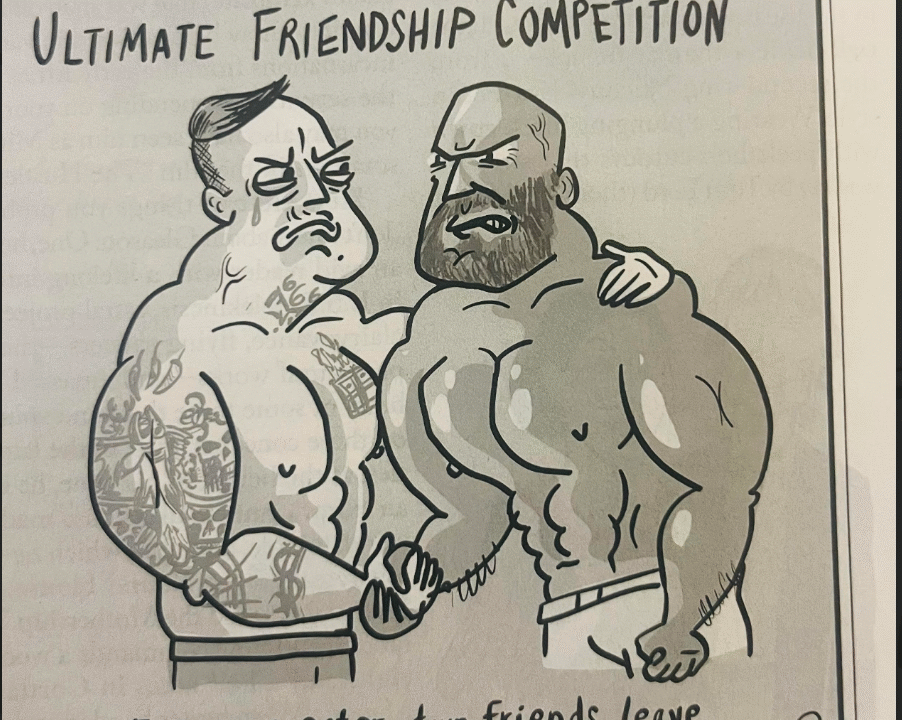

Our Current Relationship & Connection Paradox


This is the second post in our Tribe of 12 series. If you missed our introduction to why relationships matter more than ever, you can start here.
Picture this: You wake up and immediately check your phone. Dozens of notifications await—Instagram likes, LinkedIn connections, text messages, Facebook updates. You scroll through hundreds of posts from “friends” and “followers.” You’re constantly reachable, always plugged in, perpetually connected to thousands of people around the world.
So why do you feel so alone?
The Great Illusion of Digital Connection
Here’s the uncomfortable truth we need to face: being constantly connected isn’t the same as being meaningfully connected.
Our digital-first world has created a relationship paradox that’s quietly devastating our well-being. We have more ways to connect than any generation in history, yet we’re experiencing unprecedented levels of loneliness and social isolation.
The statistics are startling:
Between 1990 and 2020, the percentage of Americans who report having no close friends quadrupled. Think about that for a moment—in just three decades, we’ve managed to engineer isolation into the most connected society ever created.
But it gets worse:
- 54% of Americans report that no one knows them well
- Nearly 40% of Americans now have only online friendships
- Among teenagers, this trend is even more pronounced
These aren’t statistics about older adults in nursing homes. This phenomenon is occurring across all age groups in our increasingly hyper-connected society.
The Time Thief: How Digital Stole Our Real Relationships
The numbers tell a clear story of what we’ve traded away:
- 2013: Americans spent 6.5 hours per week with friends
- 2019: That dropped to 4 hours (a 38% decline)
- 2021: As the pandemic eased, it was down to just 2.7 hours per week (a 58% total decline)
While our time with real friends plummeted, our time with digital “connections” exploded. We chose the simulation over the real thing—and we’re paying a steep price.
Why Your Brain Can’t Tell the Difference (But Your Life Can)
To understand why this matters so much, we must revisit our evolutionary roots.
For virtually all of human history, survival depended on membership in close-knit clans and tribes. Being cast out from your group meant certain death from cold, starvation, or predators.
This is why your brain evolved to treat social rejection like physical pain—literally activating the same neural regions. It’s also why you care so deeply about others’ approval, even from people you’ve never met.
Your ancient brain doesn’t distinguish between being rejected by your life-sustaining Tribe and getting fewer likes on Instagram. As the ancient Chinese philosopher Lao Tzu wrote: “Care about people’s approval and you will be their prisoner.”
Social media platforms have weaponized this evolutionary vulnerability, designing systems to keep you scrolling, comparing, and seeking validation from an endless stream of strangers who have no real impact on your life.
The Three-Headed Monster: How Social Media Amplifies Loneliness
Psychologists have identified exactly how social media creates what I call “The Envy Engine”—amplifying our worst relational instincts through three mechanisms:
1. Comparison Overload
It constantly shows you the lives of people more fortunate than you, creating a never-ending highlight reel of everyone else’s best moments.
2. Performance Pressure
It makes it easier for anyone to flaunt their good fortune to the masses, turning life into a curated performance rather than an authentic experience.
3. False Communities
It puts you in virtual communities with people who aren’t part of your real-life community, making you compare yourself to individuals whose lives have no bearing on yours.
Celebrity and influencer posts are particularly toxic, creating what researchers call “unnecessary envy” toward people you’ll never meet, whose lives are carefully curated illusions.
The result? We’re comparing our real lives to everyone else’s highlight reels, feeling inadequate about relationships that don’t even exist.
The Great COVID Experiment: When Digital Proved Inadequate
The pandemic served as a massive, involuntary experiment in the comparison between digital and real connections. Suddenly, millions of people were forced to rely primarily on virtual interactions for months or years.
If digital connections were truly equivalent to real ones, we should have been fine during lockdown.
Instead, reports of depression, anxiety, and loneliness skyrocketed globally. Researchers who surveyed nearly 3,000 adults during the early months of the pandemic found that email, social media, online gaming, and texting were inadequate substitutes for in-person interactions.
The experiment’s results were clear: digital connections can’t replace the real thing.
The Spectator Trap: When “Keeping Up” Becomes Passive Consumption
Here’s where the illusion becomes particularly insidious: 93% of U.S. Facebook users say they use the app to “keep up with friends and family.”
But scrolling through photos of your college roommate’s vacation or liking your cousin’s anniversary post isn’t actually keeping up with them—it’s consuming a curated performance of their life.
You’re not connecting; you’re spectating.
Your brain, desperate for real social connection, mistakes this passive consumption for actual relationship maintenance. Meanwhile, when was the last time you had a real conversation with that college roommate or cousin?
What researchers call “low-dimensionality communications”—texts, DMs, social media comments—encourage us to go from person to person, swapping depth for breadth. It’s like a fast-food relationship: convenient, abundant, but ultimately unsatisfying and unhealthy.
A 2021 study confirmed what many of us intuitively know: people who engaged in more face-to-face communication felt more understood and were more satisfied with their relationships. The medium truly is the message when it comes to human connection.
The Dunbar Limit: Why Your Brain Can’t Handle Your Friend List
British behavioral psychologist Robin Dunbar theorized in 1993 that humans can cognitively maintain approximately 150 meaningful relationships. This “Dunbar number” represents a hard limit imposed by our brain’s capacity.
Yet consider the disconnect:
- The average Facebook user has 338 friends
- Instagram users follow hundreds or thousands of accounts
- LinkedIn encourages us to connect with anyone and everyone in our professional sphere
We’re trying to maintain far more connections than our brains can handle, which means most of them are necessarily shallow, performative, and ultimately meaningless to our well-being.
The Happiness Recession: The Data Doesn’t Lie
The data on American happiness tells the story. Between 1990 and 2018, the share of Americans who put themselves in the lowest happiness category increased by more than 50%.
This isn’t correlation—it’s a direct consequence of prioritizing digital connections over genuine relationships.
The whole picture is sobering:
- 36% of Americans report feeling lonely frequently or almost all the time
- The number of American adults without a romantic partner increased by a third
- Young people, despite being the most “connected” generation ever, report higher rates of loneliness than the elderly
We’ve created the most connected yet loneliest generation in human history.
Breaking Free: The Real Question You Need to Ask
The solution isn’t to abandon technology entirely—that’s neither practical nor necessary. Instead, we need to recognize that not all connections are created equal.
Your thousand LinkedIn connections won’t be there for you at 2 AM when you’re having a crisis. Your Instagram followers won’t help you move apartments or celebrate your real victories. Your Facebook friends won’t challenge you to grow or provide the deep support you need to thrive.
What you need is what humans have always needed: a small, intentional circle of genuine relationships that offer real value, real support, and genuine connection.
The question isn’t how many people you’re connected to online. The question is: who would show up for you in real life?
That’s where the real work of building your Tribe begins.
Your Next Step: Beyond the Paradox
Understanding this paradox is the first step toward building a relationship strategy that serves your life. In our next post, we’ll dive into the science of why certain types of relationships are essential for your success, health, and happiness—and introduce you to the 12 relationship archetypes that high-performers intentionally cultivate.
Because once you see the problem clearly, you can start building the solution.
Ready to audit your current relationships? Download our free guide to the 12 Essential Relationship Archetypes and discover who might be missing from your inner circle.
You Are the Average of the 12 People You Spend the Most Time With
Download our research-backed guide to the 12 essential relationship archetypes that successful people intentionally cultivate—and discover who’s missing from your inner circle.
Get your FREE ebook Now
Want more insights like this?
Subscribe to The Dispatch for weekly strategies on building relationships that actually matter.